
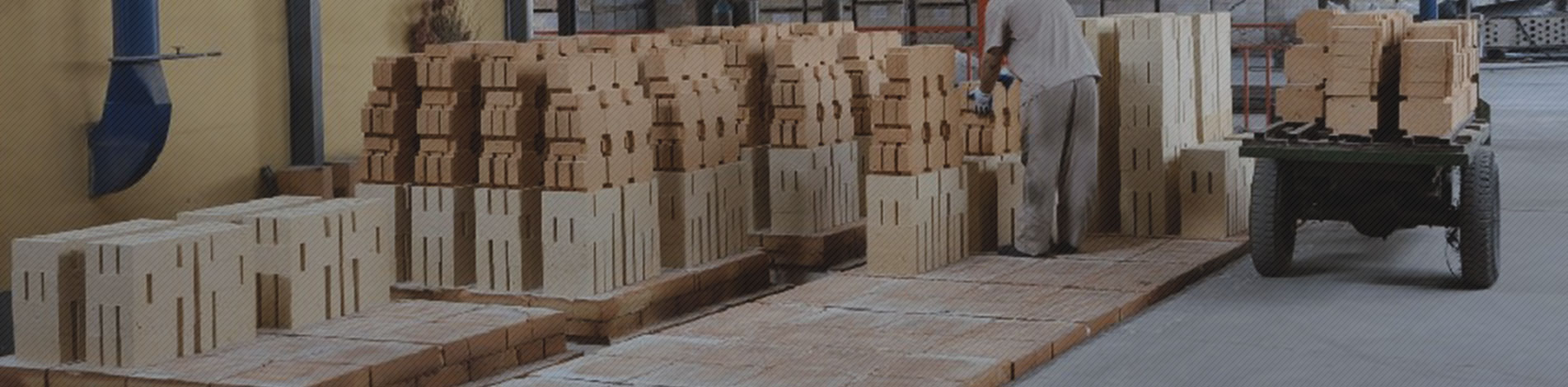

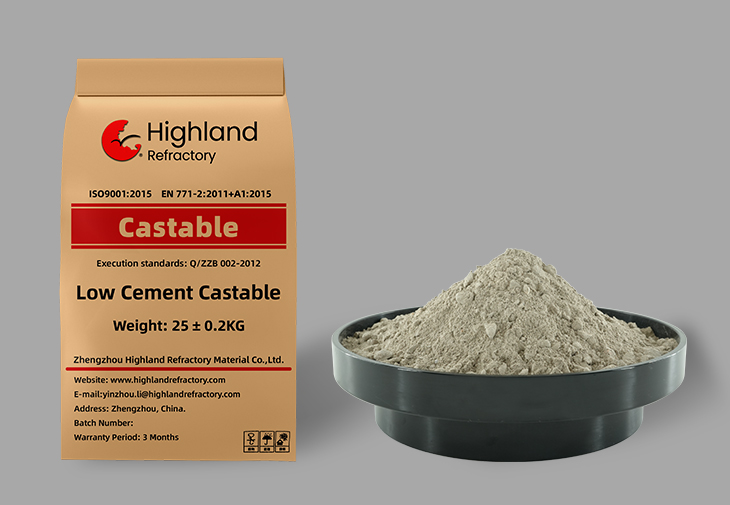
Highland Refractory’s Low Cement Castable is a premium monolithic refractory with cement content <8%, engineered for extreme high-temperature industrial environments. As a trusted Low Cement Castable Supplier, we offer variants like ultra low cement castable refractory (cement <3%) and Ic castable, blending high-purity alumina aggregates with microsilica and hydraulic binders for exceptional performance. Key technical parameters include service temperature 1600–1700°C, compressive strength ≥60MPa (after firing at 1100°C), and linear shrinkage ≤1.2% (1400°C), ensuring structural stability under thermal cycling.
Ideal for steel ladles, cement kiln liners, CFB boiler components, and petrochemical reactors, this low cement castable refractory minimizes hydration-induced cracking and resists slag erosion. Its dense matrix enhances heat retention, cutting energy costs, while extended service life reduces maintenance downtime. Whether you need ultra low cement castable for critical high-load applications or standard Low Cement Castable for general use, Highland delivers reliable, compliant solutions that drive operational efficiency for global procurement teams and end-users.

Home › Low Cement Castable › Heating Schedule A low cement castable heating schedule has one job: let water leave the lining faster than it turns to steam inside it. Miss that balance and the lining you just paid to install cracks or sheds slabs on the first heat-up, before it ever sees process temperature. For most single-component low cement castable linings the working sequence is short. Cure for at least 24 hours. Raise the hot face to 149°C (300°F). Hold there for 1.5 hours per 25 mm of thickness, capped at 8 hours. Climb at 28°C/h (50°F/h) to operating temperature or 540°C (1000°F), whichever comes first, and open the rate up above 540°C only if the lining is thin enough to take it. Two mistakes cause most dry-out failures on site: compressing the 149°C hold because the shutdown is late, and pushing the burners early because the thermocouple looks slow. Both put steam pressure ahead of the lining’s green strength. 24 h min cure Above 10°C, kept damp. 48–72 h is better where the programme allows. 149°C hold 1.5 h per 25 mm of thickness, maximum 8 hours in one hold. 28°C/h climb Rate to 540°C or operating temperature,...

Home › Monolithic › Castable Series › China LCC Manufacturer Highland Refractory is a china low cement castable manufacturer in Xinmi, Zhengzhou, making monolithic refractories since 1993. We produce both standard LCC and ultra low cement castable (ULCC) for steel, cement, incineration and non-ferrous plants, and we supply them wholesale to distributors, EPCs and end users overseas. This page covers what we make, our plant and capacity, how we certify and inspect each lot, and the wholesale terms and MOQ we offer. Since 1993 Monolithic refractory plant in Xinmi LCC & ULCC Standard and sub-1% CaO grades ISO 9001 Quality system, lot MTC issued MOQ 1 t Mixed grades in one shipment Request wholesale pricing Contents 1. Why choose our factory 5. Wholesale & distribution partnership 2. Product range (LCC & ULCC) 6. Wholesale terms: MOQ, lead time, packing 3. Manufacturing capacity & facility 4. Certifications, inspection & audit 7. FAQ 8. Conclusion 1. Why Choose Our Low Cement Castable Factory We operate as a low cement castables manufacturer inside the Xinmi refractories cluster, where calcined bauxite and tabular alumina are sourced within a short haul of the plant. That short supply chain is why we can quote both LCC...

Ultra low cement castable is the top of the low-cement family: a monolithic refractory formulated with under 1.0% CaO, against 1.0–2.5% for a standard LCC. That extra reduction in lime — achieved with 2–5% calcium aluminate cement, more reactive alumina and silica fume, and a tighter dispersant package — is what gives a ULCC its signature traits: higher bulk density, higher hot strength, and markedly better resistance to slag penetration. When a lining faces molten slag or alkali vapour at close range, this is the grade that holds the line longest.
Home › Low Cement Castable › Heating Schedule A low cement castable heating schedule has one job: let water leave the lining faster than it turns to steam inside it. Miss that balance and the lining you just paid to install cracks or sheds slabs on the first heat-up, before it ever sees process temperature. For most single-component low cement castable linings the working sequence is short. Cure for at least 24 hours. Raise the hot face to 149°C (300°F). Hold there for 1.5 hours per 25 mm of thickness, capped at 8 hours. Climb at 28°C/h (50°F/h) to operating temperature or 540°C (1000°F), whichever comes first, and open the rate up above 540°C only if the lining is thin enough to take it. Two mistakes cause most dry-out failures on site: compressing the 149°C hold because the shutdown is late, and pushing the burners early because the thermocouple looks slow. Both put steam pressure ahead of the lining’s green strength. 24 h min cure Above 10°C, kept damp. 48–72 h is better where the programme allows. 149°C hold 1.5 h per 25 mm of thickness, maximum 8 hours in one hold. 28°C/h climb Rate to 540°C or operating temperature,...
Home › Monolithic › Castable Series › China LCC Manufacturer Highland Refractory is a china low cement castable manufacturer in Xinmi, Zhengzhou, making monolithic refractories since 1993. We produce both standard LCC and ultra low cement castable (ULCC) for steel, cement, incineration and non-ferrous plants, and we supply them wholesale to distributors, EPCs and end users overseas. This page covers what we make, our plant and capacity, how we certify and inspect each lot, and the wholesale terms and MOQ we offer. Since 1993 Monolithic refractory plant in Xinmi LCC & ULCC Standard and sub-1% CaO grades ISO 9001 Quality system, lot MTC issued MOQ 1 t Mixed grades in one shipment Request wholesale pricing Contents 1. Why choose our factory 5. Wholesale & distribution partnership 2. Product range (LCC & ULCC) 6. Wholesale terms: MOQ, lead time, packing 3. Manufacturing capacity & facility 4. Certifications, inspection & audit 7. FAQ 8. Conclusion 1. Why Choose Our Low Cement Castable Factory We operate as a low cement castables manufacturer inside the Xinmi refractories cluster, where calcined bauxite and tabular alumina are sourced within a short haul of the plant. That short supply chain is why we can quote both LCC...
Ultra low cement castable is the top of the low-cement family: a monolithic refractory formulated with under 1.0% CaO, against 1.0–2.5% for a standard LCC. That extra reduction in lime — achieved with 2–5% calcium aluminate cement, more reactive alumina and silica fume, and a tighter dispersant package — is what gives a ULCC its signature traits: higher bulk density, higher hot strength, and markedly better resistance to slag penetration. When a lining faces molten slag or alkali vapour at close range, this is the grade that holds the line longest.

Low cement castable is a family of monolithic refractories formulated with 1.0–2.5% CaO — roughly one third of the lime carried by a conventional castable. That single change, less calcium aluminate cement combined with reactive micro-fines and a high-efficiency dispersant, cuts mixing water from 10–13% down to 4–6%. In doing so it removes most of the capillary porosity that shortens lining life. The result is a material that is denser, stronger and considerably more resistant to slag penetration than the castables it replaced.
Since the 1980s, low cement castable has become the default choice for high-wear monolithic linings in cement, steel, power generation and waste incineration. This page covers the definition, the technical data sheet values you need for specification, the four main grades by raw material, the three installation forms, what drives the price, and where each grade belongs. If you only need the short version, the five decision factors in section 7 will get you to a shortlist in about ten minutes.
Contents
The definition of a low cement castable rests on one number: the lime (CaO) content of the finished mix. Low cement castable definition in industry practice is a refractory castable containing 1.0–2.5% CaO, which corresponds to roughly 5–8% calcium aluminate cement in the dry batch. Above that band you are looking at a conventional castable; below it, an ultra-low or cement-free material.
Reducing the cement alone achieves very little. What makes the low-cement system work is a package of three changes that are always introduced together. First, the calcium aluminate cement content drops. Second, reactive micro-fines — silica fume, reactive alumina, or both — fill the voids between aggregate particles so the mix flows with far less water. Third, a dispersing agent (typically a polycarboxylate or sodium hexametaphosphate) deflocculates the fine fraction so the particles pack tightly instead of clumping. Lower water means lower porosity after firing, and lower porosity is what produces the jump in strength and slag resistance.
| Class | CaO content | Cement addition | Water demand | Typical use |
|---|---|---|---|---|
| Conventional castable | > 2.5% (typically 4–8%) | 15–25% | 10–13% | General purpose, low-abuse zones |
| Low cement castable (LCC) | 1.0–2.5% | 5–8% | 4–6% | High-wear and high-temperature linings |
| Ultra-low cement (ULCC) | 0.2–1.0% | 2–5% | 3.5–5% | Severe slag corrosion, maximum hot strength |
| Cement-free (sol-bonded) | < 0.2% | < 1% | 4–6% | Reducing atmospheres, very high purity |
A conventional castable carries enough cement to generate hydraulic setting on its own, but each percent of cement also introduces lime that forms low-melting phases with alumina and silica at service temperature. Those liquid phases are the reason a conventional castable loses strength sharply above about 1200°C. A low cement refractory castable keeps enough cement to demould and green-handle, but not enough to compromise the hot strength. If you want the full parameter-by-parameter breakdown, see our dedicated comparison of conventional vs low cement castable.
The boundary between the two is 1.0% CaO. Below it you gain further hot strength and corrosion resistance, but you also lose some of the forgiving workability that makes LCC easy to place on site, and the material becomes more sensitive to water quality and mixing discipline. If your lining sees molten slag or alkali vapour at close range, an ultra low cement castable is usually worth the extra cost. If it sees abrasion, thermal cycling and mechanical impact, standard LCC is the better value.
The tables below give typical values for the four commercial grades we supply. They are representative production averages, not guaranteed limits on any single batch; the certified values for a specific lot are printed on the lot inspection certificate issued with every shipment. All values are measured on specimens prepared at the stated water addition and fired under the stated schedule. Low-cement castables are supplied pre-blended with the dispersing agent already dosed, so these figures assume no site adjustment to the fine fraction.

| Grade | Al₂O₃ | SiO₂ | CaO | Fe₂O₃ | Water addition |
|---|---|---|---|---|---|
| High alumina LCC | 70–80% | 10–18% | 1.5–2.5% | ≤ 1.2% | 5.0–6.0% |
| Corundum LCC | ≥ 92% | ≤ 3% | 1.0–1.8% | ≤ 0.5% | 4.0–5.0% |
| Andalusite LCC | 55–62% | 33–40% | 1.5–2.5% | ≤ 1.0% | 5.5–6.5% |
| Mullite LCC | 66–74% | 20–28% | 1.2–2.2% | ≤ 1.0% | 5.0–6.0% |
| Property | High alumina | Corundum | Andalusite | Mullite |
|---|---|---|---|---|
| Bulk density, 110°C (g/cm³) | 2.65–2.80 | 2.95–3.15 | 2.45–2.60 | 2.55–2.70 |
| Bulk density, fired (g/cm³) | 2.60–2.75 | 2.90–3.10 | 2.40–2.55 | 2.50–2.65 |
| Cold crushing strength, 110°C (MPa) | 70–95 | 90–130 | 55–75 | 65–85 |
| Cold crushing strength, fired (MPa) | 90–130 | 120–170 | 70–95 | 85–115 |
| Modulus of rupture, fired (MPa) | 12–18 | 18–26 | 9–14 | 11–16 |
| Permanent linear change, fired (%) | ± 0.3 | ± 0.2 | ± 0.4 | ± 0.3 |
| Thermal conductivity @ 1000°C (W/m·K) | 1.6–1.9 | 2.0–2.4 | 1.3–1.6 | 1.4–1.7 |
| Maximum service temperature (°C) | 1500–1600 | 1650–1750 | 1400–1500 | 1450–1550 |
| Thermal shock cycles, 950°C water quench | ≥ 25 | ≥ 20 | ≥ 40 | ≥ 35 |
Lime, alumina and silica form a ternary system whose lowest melting point sits near 1380°C. Every additional percent of CaO in a castable pushes more of its bond phase toward that eutectic, which is why conventional castables soften and creep well before their aggregate would fail on its own. Holding CaO between 1.0% and 2.5% keeps the amount of glassy phase small enough that the ceramic bond — the direct sintering of fine alumina and mullite particles — carries most of the load at temperature. That ceramic bond is also why a low cement castable gains strength on firing instead of losing it, and why its hot modulus of rupture stays high where a conventional castable would already be deforming.
The cement system sets the class; the aggregate sets the grade. Four raw material systems cover almost every industrial application, and choosing between them is mostly a matter of temperature, corrosion environment and thermal cycling severity.

High alumina low cement castable, typically 70–80% Al₂O₃, is the workhorse of the family. It balances hot strength, abrasion resistance and price well enough to be the default specification for kiln noses, cooler sections, boiler walls and general-purpose high-wear linings. Bulk density sits around 2.7 g/cm³ and maximum service temperature around 1550°C. Where the environment is oxidising and the load is mechanical rather than chemical, this grade is usually the right first answer. We also supply a high alumina refractory brick range for zones where a fired shape outperforms a monolithic.
Corundum low cement castable pushes Al₂O₃ above 92%, which raises density to roughly 3.0 g/cm³ and cold crushing strength to 120–170 MPa after firing. It is the grade specified where molten metal, aggressive slag or alkali vapour contacts the lining directly — steel ladle covers, RH snorkels, aluminium holding furnace belly bands and waste incinerator side walls. The trade-off is thermal shock: corundum's high elastic modulus makes it less forgiving under rapid cycling, so it performs best in linings that run continuously rather than in batch equipment that cools down every shift.
Andalusite low cement castables are chosen for thermal shock resistance rather than peak temperature. The andalusite grain converts to mullite in service with a small permanent expansion, which keeps the lining tight against its anchors and closes the micro-cracks that thermal cycling opens in other grades. Expect 40 or more water-quench cycles from 950°C, roughly double what a high alumina grade survives. Service temperature tops out around 1500°C, and the lower alumina content means lower material cost. Typical applications include ladle preheaters, torpedo car covers and any vessel that cycles hot–warm frequently.
Mullite low cement castable sits between the high alumina and andalusite grades. It delivers better thermal shock resistance than high alumina without giving up as much temperature capability as andalusite, which makes it a common choice for CFB boiler cyclones, incinerator secondary chambers and petrochemical heater floors. Some buyers search for this material using the spelling variant low cement mulite refractory castable; both spellings refer to the same mullite-based product family.
| If your lining needs | Choose | Max service temp | Relative cost |
|---|---|---|---|
| Best abrasion resistance for the money | High alumina LCC | 1500–1600°C | Base |
| Maximum slag and penetration resistance | Corundum LCC | 1650–1750°C | 2.0–2.2× |
| Maximum thermal shock resistance | Andalusite LCC | 1400–1500°C | 1.1–1.3× |
| Balance of shock resistance and temperature | Mullite LCC | 1450–1550°C | 1.5–1.7× |
| Severe corrosion plus maximum hot strength | ULCC grades | 1700–1800°C | 2.4–2.8× |
The same base formulation can be delivered in three placement forms. Picking the right one is usually decided by access and geometry rather than by performance, and getting it wrong costs more in labour than the material itself ever will.
Low cement gunning castable is dry-mixed, conveyed pneumatically and wetted at the nozzle, which lets you place material on vertical and overhead surfaces without formwork. It is the standard method for kiln nose rings, cooler throat sections and repair work where shutting down long enough to build forms is not viable. Two numbers determine whether a gunning job succeeds: water control at the nozzle, and rebound. Rebound — the fraction of coarse aggregate that bounces off the surface — typically runs 10–20% for a well-tuned low cement mix. Because rebound is disproportionately coarse, the placed material is slightly finer and slightly more cement-rich than the bagged mix, so specify gunning grades with that shift in mind.
Low cement self flow castables are engineered to level and de-air under their own weight, with flow values typically between 180 mm and 220 mm on the standard flow table. No vibration is needed, which matters when the section is heavily reinforced with anchors, when the formwork cannot carry a vibrator load, or when the cavity is deep and narrow. Self-flow mixes are more sensitive to water than vibrating grades: an extra half percent over target can cause aggregate segregation and a weak surface layer, so batching discipline matters more than with any other form.
Standard vibration remains the lowest-risk method wherever formwork and access allow it. A low cement mix placed this way needs only 30–60 seconds of immersion vibration per pocket, and over-vibration is a more common fault than under-vibration. Vibration produces the most consistent density of the three methods and is the baseline against which the datasheet values in section 2 are measured.
Whichever form you place, the lining then has to be cured and dried before it sees service temperature. Curing is straightforward: keep the surface wet or covered for 24 hours at ambient temperature so the cement hydrates. Drying is where most premature failures happen. Free water must leave below 100°C and chemically combined water between roughly 150°C and 350°C, and if the temperature rises faster than the vapour can escape, internal steam pressure spalls the lining. Rates of 10–15°C per hour through the critical band, with holds at 110°C and 350°C, are typical. We publish the full curve with hold times by lining thickness in our separate guide to the low cement castable heating schedule.
Buyers usually open with the price per ton, and that number is the least useful figure on the page. Below are indicative ranges to frame a budget, followed by the six variables that actually move the quote, and then a worked example of why the cheapest grade is often the most expensive lining.
Price data is indicative. The ranges below are reference bands for budget planning, FOB Qingdao, and are not a firm offer. Final low cement castable prices depend on order volume, packaging, specification tolerances and freight at the time of order. Ask for a written quotation for accurate numbers.
| Grade | Al₂O₃ content | Indicative price (USD/t) | Typical MOQ |
|---|---|---|---|
| High alumina LCC | 70–80% | 450 – 750 | 1 ton |
| Andalusite LCC | 55–62% | 550 – 850 | 1 ton |
| Mullite LCC | 66–74% | 700 – 1,100 | 1 ton |
| Corundum LCC | ≥ 92% | 900 – 1,600 | 1 ton |
| ULCC (ultra low cement) | 75–95% | 1,100 – 1,900 | 1 ton |
The single largest cost driver. Moving from 70% to 90% Al₂O₃ roughly doubles raw material cost, because the aggregate shifts from bauxite to tabular or fused alumina.
Fused and tabular alumina cost more than sintered bauxite at equivalent chemistry. Fused grain buys toughness and purity; sintered buys price.
Reactive alumina micro-fines and high-performance dispersants are a small mass fraction and a large cost fraction. ULCC systems use more of both.
Full container loads carry markedly lower unit cost than part loads, mostly through packaging and handling rather than raw material.
Tight chemistry limits, third-party inspection and certified lot testing all add cost. Worth it only when the application genuinely demands it.
Moisture-barrier bags with palletisation cost more than bulk jumbo bags but protect a material that is ruined by absorbed water.
Consider a kiln nose ring. A conventional castable at 380 USD per ton lasts about six months. A low cement castable at 620 USD per ton lasts fourteen. Over a 28-month window the conventional option needs 4.7 relines and the low cement option needs 2. Material cost is roughly comparable, but the conventional route consumes two extra shutdowns. If a shutdown costs 18,000 USD in lost production and contractor labour, the conventional lining is about 36,000 USD more expensive over the same period, on a lining that looked 63% cheaper on the purchase order.
This is the calculation that matters, and it is the one we run with customers before quoting. Give us the service temperature, the corrosion environment, the cycle pattern and your current campaign length, and we will model it for your furnace rather than quoting a tonnage price in isolation.
Get a quotation as a low cement castable manufacturer
The table below maps the furnace types we supply most often to the grade that usually performs best in each zone. A low cement refractory castable can be specified into almost any monolithic lining; what changes between zones is the aggregate chemistry, the lining thickness and the installation form. Where two grades are listed, the choice comes down to whether abrasion or thermal cycling dominates in your specific unit.

| Furnace / zone | Recommended grade | Service temp | Primary demand |
|---|---|---|---|
| Cement rotary kiln, nose ring and discharge | High alumina or corundum | 1400–1500°C | Abrasion, thermal cycling, alkali |
| Cement kiln, cooler throat and take-off | High alumina LCC | 1200–1400°C | Abrasion from clinker |
| Steel ladle cover and lip | Corundum or ULCC | 1550–1650°C | Slag corrosion, thermal shock |
| Reheating furnace, skid and hearth | High alumina LCC | 1300–1450°C | Abrasion, scale attack |
| CFB boiler, cyclone and return leg | Mullite or high alumina | 850–1000°C | High-velocity solid erosion |
| Waste incinerator, side wall and secondary chamber | Corundum or high alumina | 1100–1300°C | Alkali and chloride attack |
| Aluminium holding and melting furnace, belly band | Corundum LCC | 750–900°C | Resistance to molten aluminium penetration |
| Petrochemical heater, floor and burner block | Mullite or andalusite | 1200–1400°C | Thermal cycling, flame impingement |
Two notes on reading the table. First, the temperatures listed are gas or metal temperatures rather than refractory hot-face temperatures; the hot face normally runs 50–150°C below the gas in a fired heater, and closer to the metal in a holding furnace. Second, where a low cement refractory castable is backed by an insulating layer, the dense layer must be anchored through the insulation to the shell rather than to the insulation itself, or it will shear away under its own weight once the anchors lose strength at temperature.
Work through these five in order. In most cases the first two will narrow the field to one grade, and the remaining three will confirm or adjust it.
1. Service temperature
Use the sustained metal or gas temperature, not the peak. If sustained temperature exceeds 1600°C, only corundum and ULCC grades are realistic. Between 1400°C and 1600°C, high alumina and mullite both work. Below 1400°C, all four grades are technically viable and the decision moves to the next factor.
2. Mechanical load and abrasion
Solid-particle erosion and mechanical impact call for high density and high cold crushing strength, which points to high alumina or corundum. If the lining sees sliding abrasion from clinker, coke or bed material at velocity, specify by bulk density and hot modulus of rupture rather than by alumina content alone.
3. Atmosphere and slag chemistry
Oxidising atmospheres suit every grade. Reducing atmospheres and carbon monoxide exposure rule out high-iron raw materials. Acidic slags favour high alumina and corundum; basic slags attack alumina and call for a magnesia-based system instead, which sits outside this family. Alkali vapour attacks the silica-bearing bond phase, which argues for low-silica corundum grades.
4. Thermal insulation requirement
Low cement castable is dense by design and is a poor insulator. Where heat loss matters, back it with a ceramic fibre or insulating castable layer rather than trying to find an insulating low cement grade — the two requirements are mutually exclusive in a single material.
5. Installation conditions
Decide whether the job will be cast, gunned or self-flowed before you finalise the grade, because not every formulation is available in every form. Restricted access, deep narrow cavities and heavy anchor reinforcement all favour self-flow; vertical and overhead surfaces favour gunning; open horizontal pours favour vibration.
Send us the service temperature, the corrosion environment, the cycling pattern, the lining thickness and your current campaign length. We will recommend a grade and explain the reasoning, whether or not the answer is the more expensive option.
Low cement castable is a monolithic refractory containing 1.0–2.5% CaO, produced with 5–8% calcium aluminate cement plus reactive micro-fines and a dispersing agent. The low cement content reduces mixing water to 4–6%, which produces a denser, stronger lining with better slag resistance than a conventional castable.
Between 1.0% and 2.5% by weight. Conventional castables carry more than 2.5%, typically 4–8%. Ultra-low cement castables carry 0.2–1.0%, and cement-free or sol-bonded systems fall below 0.2%. The CaO figure is the standard way to classify a castable, and it is more reliable than the cement addition percentage because raw material purity varies between suppliers.
Bulk density depends on the grade. High alumina low cement castable runs 2.65–2.80 g/cm³ after drying at 110°C. Corundum grades reach 2.95–3.15 g/cm³, mullite grades 2.55–2.70 g/cm³, and andalusite grades 2.45–2.60 g/cm³. Densities drop slightly after firing as the bond phase dehydrates and sinters.
Indicative ranges, FOB Qingdao, run from about 450–750 USD per ton for high alumina grades, 550–850 USD for andalusite, 700–1,100 USD for mullite, and 900–1,600 USD for corundum. Ultra-low cement grades start around 1,100 USD. These are budget bands rather than firm quotes — volume, specification tolerance, packaging and freight all move the final number.
The dividing line is 1.0% CaO. Ultra-low cement castable carries 0.2–1.0% CaO, which gives higher hot strength and better slag penetration resistance, but with less workable placement and stricter water control requirements. Choose ULCC when molten slag or alkali vapour contacts the lining directly; standard LCC is better value for abrasion and thermal cycling. Full comparison on our ultra low cement castable page.
Yes. Low cement gunning castable is a standard product form, used where formwork is impractical or shutdown time is short. Expect rebound of 10–20% with a correctly tuned mix, and bear in mind that the placed material ends up slightly finer and more cement-rich than the bagged mix, because rebound is disproportionately coarse aggregate.
Cure for 24 hours at ambient temperature with the surface kept wet or covered. Then dry slowly: hold at 110°C, ramp at 10–15°C per hour through the 150–350°C band where combined water is released, hold again at 350°C, then increase to 25–50°C per hour. Hold times scale with lining thickness. Rushing this stage is the most common cause of explosive spalling. The complete curve is published in our heating schedule guide.
Campaign length depends far more on the furnace and its operating discipline than on the material alone. As a working comparison, a kiln nose ring lined with conventional castable typically runs around six months, while the same zone lined with low cement castable commonly runs twelve to sixteen months. In erosion service such as CFB cyclones, twelve to twenty-four months is typical. The largest variable is drying discipline during the first heat-up.
Low cement castable refractory earns its premium over a conventional castable through density, hot strength and slag resistance — and it repays that premium most reliably when the grade matches the actual failure mechanism in your furnace rather than the highest temperature on the drawing. We have been manufacturing monolithic refractories in Xinmi, Zhengzhou since 1993, and we will tell you when a cheaper grade will do the job.
Send the service temperature, corrosion environment, cycling pattern, lining thickness and target campaign length. You will get a grade recommendation with reasoning, an indicative price, and a datasheet — usually within one working day.
Request a quotationUltra low cement castable is the top of the low-cement family: a monolithic refractory formulated with under 1.0% CaO, against 1.0–2.5% for a standard LCC. That extra reduction in lime — achieved with 2–5% calcium aluminate cement, more reactive alumina and silica fume, and a tighter dispersant package — is what gives a ULCC its signature traits: higher bulk density, higher hot strength, and markedly better resistance to slag penetration. When a lining faces molten slag or alkali vapour at close range, this is the grade that holds the line longest.
