

Highland Refractory is an ISO-certified Chinese ceramic fiber module manufacturer and industrial furnace lining solution supplier. Engineered from continuous, high-purity alumina-silica spun ceramic fiber blankets, our refractory modules are mechanically pre-compressed and banded under factory-controlled pressure to deliver seamless, thermal-shock-resistant hot-face furnace linings operating continuously from 1050°C up to 1430°C.
Whether your facility requires standardized folded ceramic fiber modules, precision monolithic compressed blocks, or eco-friendly bio-soluble (AES) fiber modules complete with custom heat-resistant stainless steel anchors (SS304 / SS310 / Inconel 601), we provide end-to-end engineering support—including CAD lining thermal design, anchor stress analysis, and full-container export packaging.

A ceramic fiber module is a factory-fabricated, pre-compressed refractory lining unit engineered from continuous spun alumina-silica fiber blankets folded under multi-directional hydraulic pressure. Embedded with a heat-resistant stainless steel anchoring assembly (SS304 / SS310 / Inconel 601), our ceramic fiber modules are engineered for continuous thermal service from 1050°C up to 1430°C. By eliminating the high thermal mass and mortar-joint failures of dense firebricks and monolithic castables, Highland modules cut furnace heat loss by 20% to 40%. For full product category overviews and multi-grade wholesale supply, explore our dedicated Ceramic Fiber Module Manufacturer & Supplier Hub.
A ceramic fiber module is a factory-fabricated, pre-compressed refractory lining unit engineered from continuous spun alumina-silica fiber blankets folded under multi-directional hydraulic pressure. Embedded with a heat-resistant stainless steel anchoring assembly (SS304 / SS310 / Inconel 601), our ceramic fiber modules are engineered for continuous thermal service from 1050°C up to 1430°C. By eliminating the high thermal mass and mortar-joint failures of dense firebricks and monolithic castables, Highland modules cut furnace heat loss by 20% to 40%. For full product category overviews and multi-grade wholesale supply, explore our dedicated Ceramic Fiber Module Manufacturer & Supplier Hub.
1050°C – 1430°C Classification Temp

As a specialized industrial ceramic fiber module factory, Highland fabricates modules across multiple structural fold formats and chemistry grades to match exact furnace operating atmospheres, mechanical vibration levels, and installation geometries:
Fabricated by accordion-folding continuous ceramic fiber blanket into accordion bellows under multi-directional pre-compression. Features edge-grain hot face exposure for maximum gas-velocity resistance.
Formulated with 15%–17% ZrO&sub2; to prevent fiber crystallization and devitrification at continuous temperatures exceeding 1300°C. Retains high elasticity and low thermal shrinkage in severe duty cycles.
Manufactured through edge-stacked pre-compressed blanket slices or homogeneous vacuum-formed fiber blocks. Provides a completely flat, non-pleated surface with uniform multi-axis density distribution.
Formulated from alkaline-earth silicate (AES) chemistry. Meets strict European REACH and Nota Q regulatory standards with low biopersistence while maintaining 1050°C–1200°C thermal insulation efficiency.
All Highland refractory modules come with pre-assembled internal anchoring hardware (central tube, butterfly clips, or corner brackets) engineered to remain buried on the cold-face side away from aggressive gases.
Engineered multi-layer insulation combining ceramic fiber modules with high-density ceramic fiber boards for burner blocks and flexible blanket back-up layers.
In high-temperature thermal processing, converting traditional dense refractory bricks or heavy refractory castables to refractory ceramic fiber modules represents one of the most cost-effective energy modernization strategies available:
| Performance Metric | Ceramic Fiber Module Lining | Heavy Firebrick / Castable Lining | Engineering Benefit |
|---|---|---|---|
| Weight / Structural Load | 192 – 240 kg/m³ | 2,100 – 2,600 kg/m³ | > 85% lighter; reduces steel frame sizing & foundation costs. |
| Thermal Inertia / Heat Storage | Extremely low thermal capacity | High thermal mass (absorbs extensive heat) | Rapid heat-up and cool-down cycles; ideal for batch furnaces. |
| Energy Savings | Thermal conductivity ≤ 0.16 W/m•K | Thermal conductivity ≥ 1.20 W/m•K | 20% to 40% fuel/gas reduction; lower exterior shell temperatures. |
| Thermal Shock Resistance | Immune to thermal spalling / cycling | Prone to thermal cracking and spalling | Zero spalling even under extreme, rapid temperature swings. |
| Joint Integrity & Shrinkage | Pre-compressed blanket self-expands | Open expansion joints allow gas leakage | Compensates for heating shrinkage; seamless monolithic face. |
During manufacturing, our ceramic fiber blankets are compressed from an initial unconstrained density of ~128 kg/m³ up to 192–240 kg/m³ and secured with temporary plastic banding. Once installed on the furnace wall and the bands are cut, the modules expand laterally by ≥ 15%, mechanically locking adjacent blocks together and permanently eliminating hot-face seam openings during thermal cycling.

Highland Refractory supplies ceramic fiber modules in five standard industry chemistry grades. All batches are backed by traceable spectrochemical (XRF) inspection:
| Item / Property | Standard (STD) | High Purity (HP) | High Alumina (HA) | Zirconia (HZ) | Bio-Soluble (AES) |
|---|---|---|---|---|---|
| Classification Temp (°C) | 1260°C | 1260°C | 1400°C | 1430°C | 1200°C |
| Max Continuous Temp (°C) | 1050°C | 1100°C | 1250°C | 1350°C | 1000°C |
| Bulk Density (kg/m³) | 192 / 220 / 240 (Custom available upon request) | ||||
| Al&sub2;O&sub3; Content (%) | 44 – 46% | 47 – 49% | 52 – 55% | 35 – 37% | ≤ 1.0% |
| SiO&sub2; Content (%) | 51 – 53% | 50 – 52% | 44 – 47% | 48 – 50% | 60 – 70% |
| ZrO&sub2; Content (%) | — | — | — | 15 – 17% | — |
| Fe&sub2;O&sub3; Content (%) ≤ | 1.0% | 0.2% | 0.2% | 0.2% | 0.5% |
| Linear Shrinkage (24h @ temp) | ≤ -3.0% (1000°C) | ≤ -3.0% (1100°C) | ≤ -3.0% (1250°C) | ≤ -3.0% (1350°C) | ≤ -2.5% (1000°C) |
| Standard Block Dimensions | 300 × 300 × (150–350) mm • 600 × 300 × (200–300) mm | ||||
A refractory module lining is only as durable as its underlying anchoring hardware. Because ceramic fiber module anchors are buried approximately two-thirds inside the module thickness from the hot face, they operate at a significantly reduced temperature relative to the furnace atmosphere:
| Anchor Alloy Grade | Max Anchor Temperature | Suitable Furnace Atmosphere | Recommended Application |
|---|---|---|---|
| Carbon Steel (Q235) | ≤ 450°C | Clean flue gas, non-corrosive back-up | Cold-face shell connection studs & back plates |
| Stainless Steel 304 (SS304) | ≤ 750°C | Oxidizing atmosphere, low sulfur | Medium-temp annealing covers, ductwork |
| Stainless Steel 310S (SS310S) | ≤ 1100°C | High temperature, cyclical oxidation | Standard default for 1260°C–1350°C modules |
| Inconel 601 (RA330 / Nickel) | ≤ 1250°C | Carburizing, sulfur-bearing, extreme heat | Petrochemical ethylene crackers, 1430°C Zirconia roofs |

Highland Refractory modules are designed for rapid installation with minimum field downtime. We support both soldier coursing (modules aligned in identical orientation with compensation blankets between rows) and parquet (checkerboard) coursing (alternating fold directions 90° to balance multi-directional shrinkage):
Clean the furnace steel shell by removing scale, rust, and oil. Apply anti-corrosive primer coating if condensing acid dew point is expected.
Weld threaded anchor studs onto the shell using a capacitor discharge stud welding gun according to the approved CAD anchor grid layout.
Impalement of back-up blanket layer, then slide the module central anchor tube onto the stud. Tighten the locking nut firmly to the stud base.
Cut and remove temporary plastic compression straps. Lightly tamper the module face with a wooden tamper to lock folds into a monolithic joint.
Because ceramic fiber modules are held under continuous mechanical tension by their internal strapping, ocean transport packaging requires rigorous protection against strap snapping and moisture ingress:
A ceramic fiber module is a factory-fabricated, pre-compressed refractory lining unit engineered from continuous spun alumina-silica fiber blankets folded under multi-directional hydraulic pressure. Embedded with a heat-resistant stainless steel anchoring assembly (SS304 / SS310 / Inconel 601), our ceramic fiber modules are engineered for continuous thermal service from 1050°C up to 1430°C. By eliminating the high thermal mass and mortar-joint failures of dense firebricks and monolithic castables, Highland modules cut furnace heat loss by 20% to 40%. For full product category overviews and multi-grade wholesale supply, explore our dedicated Ceramic Fiber Module Manufacturer & Supplier Hub.
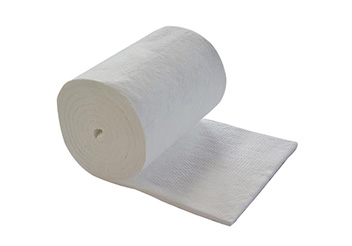
Ceramic fiber is a fibrous lightweight refractory material

Highland manufactures industrial-grade ceramic fiber blanket with aluminum foil (also known as aluminium foil faced ceramic fiber blanket). This advanced composite thermal wrap integrates a spun alumino-silicate needle-punched core rated to 1260°C (2300°F) with an exterior reinforced pure aluminum foil facing. Engineered specifically for high-temperature steam pipelines, petrochemical ductwork, boiler exterior cladding, and HVAC fireproofing, it functions simultaneously as a 97% radiant heat reflector and a zero-permeance moisture vapor barrier.

Highland Refractory manufactures high-performance ceramic fiber insulation tape engineered for critical high-temperature thermal barriers up to 1260°C (2300°F). Woven from high-purity aluminosilicate ceramic fiber yarns and reinforced with Stainless Steel (Inconel/SS304) wire or high-strength E-glass filament, our woven webbing tapes deliver superior mechanical tensile strength, ultra-low thermal conductivity, and zero asbestos hazards for pipe wrapping, boiler flange gasketing, and expansion joints. Available in standard thicknesses (2.0mm, 3.0mm, 5.0mm) and custom widths (20mm to 150mm), featuring plain weave, drop warp (bolt-hole slotted), ladder configurations, and heat-reflective aluminum foil backing.

Zhengzhou Highland Refractory Co., Ltd. is an authorized manufacturer and direct B2B exporter of industrial ceramic fiber rope (refractory insulation packing) rated for continuous service temperatures from 1260°C (2300°F) up to 1430°C (2600°F). Engineered for severe-duty furnace door seals, coke oven expansion joints, boiler header packing, and molten metal trough gaskets. We manufacture twisted, round braided, and dense square braided ropes reinforced with E-glass filament, SS304 stainless steel, or heat-resistant Inconel wire. Calibrated diameters from 3 mm up to 50 mm.

Highland Refractory manufactures high-purity ceramic fiber paper (also known as refractory alumina-silicate fiber paper) engineered for high-temperature thermal barriers, die-cut gaskets, and electrical insulation up to 1260°C (2300°F) and 1430°C (2600°F). Produced via an automated continuous wet-forming papermaking process with advanced de-slagging technology (shot content ≤ 8%), our papers deliver outstanding tensile strength, smooth surface finish, and ultra-low thermal conductivity. Available in continuous rolls and sheets in thicknesses from 0.5mm to 6.0mm (including standard 1/8″ and 1/4″ inch dimensions). Ideal for industrial furnace flanges, expansion joint fillers, petrochemical pipe wraps, and kiln shelf barrier liners.
Ceramic fiber board is a new type of refractory insulation material.
