Monolithic Refractories

Refractory Cement

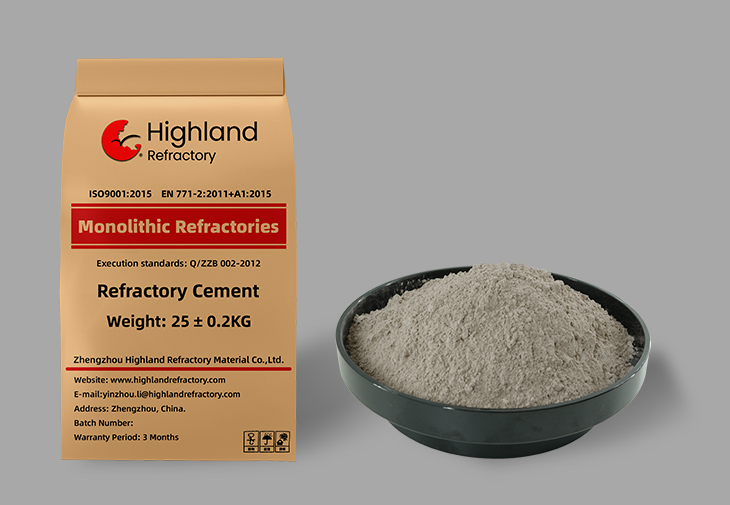
Highland Refractory’s Refractory Cement stands out for reliable high-temperature performance, with technical specs tailored to industrial demands: it features a refractory temperature ≥1650℃, normal-temperature compressive strength ≥32MPa, and a controlled setting time of 2–4 hours, plus low mixing water demand (15–18%) that minimizes shrinkage after curing.

Ideal as refractory cement for forge linings, industrial kiln repairs, and boiler joint sealing, it resists thermal shock and chemical erosion, keeping equipment running longer. As a trusted source for refractory cement for sale, we offer competitive refractory cement price 20–30% lower than Western brands without compromising quality. Easy to mix and apply, it cuts installation time by 30%, reducing labor costs. For buyers looking to buy refractory cement, our product delivers consistent results, making it a top choice for B-end clients and end-users needing durable, cost-effective high-temperature bonding solutions.

Contact us
  • Refractory Cement

    Refractory cement, also known as aluminate cement, is a fire-resistant hydraulic cementitious material.

  • Refractory Cement Wet Mortar 3000

    Industrial-grade Refractory Cement Wet Mortar 3000 (3000°F heat-resistant, ready-to-use). Ideal for kiln repair, brick bonding. ASTM-certified, 12-month warranty, bulk discounts. Request custom quote now!

  • Castable Refractory Cement

    Service Temp 800-1800℃ | ASTM/ISO Certified | Custom Formulations | Factory Direct Supply ① High Temp Stability (800-1800℃ Long-Term Service) ② Excellent Flowability (No Vibration Needed for Casting) ③ Strong Bonding & Wear Resistance (Compressive Strength ≥80MPa) ④ Fast Setting (24h Initial Setting, 72h Demolding)

  • Refractory Cement

    Refractory cement, also known as aluminate cement, is a fire-resistant hydraulic cementitious material.

  • Refractory Cement Wet Mortar 3000

    Industrial-grade Refractory Cement Wet Mortar 3000 (3000°F heat-resistant, ready-to-use). Ideal for kiln repair, brick bonding. ASTM-certified, 12-month warranty, bulk discounts. Request custom quote now!

  • Castable Refractory Cement

    Service Temp 800-1800℃ | ASTM/ISO Certified | Custom Formulations | Factory Direct Supply ① High Temp Stability (800-1800℃ Long-Term Service) ② Excellent Flowability (No Vibration Needed for Casting) ③ Strong Bonding & Wear Resistance (Compressive Strength ≥80MPa) ④ Fast Setting (24h Initial Setting, 72h Demolding)

Technical Specifications: Highland Refractory’s Refractory Cement

  • 1. Core Technical Parameters for Application Matching​

    To solve the pain point of "parameter mismatch with usage scenarios," Highland Refractory’s Refractory Cement features strictly calibrated specs tailored to diverse industrial needs. Our standard grade boasts a refractory temperature ≥1650℃, normal-temperature compressive strength ≥32MPa (after 28 days of curing), and a controlled setting time of 2–4 hours ideal for general high-temperature equipment. For specialized needs like refractory cement for forge (where extreme heat resistance is critical), we offer a high-alumina variant with Al₂O₃ content ≥70%, raising refractory temperature to ≥1750℃ and thermal shock resistance (withstanding 1100℃ quenching 25+ times). These clear parameters let clients quickly verify if the product fits their forge, boiler, or kiln applications before deciding to buy refractory cement.​

  • 2. Quality Control for Stable Performance​

    Addressing "concerns over inconsistent quality," our Refractory Cement (including all batches for refractory cement for sale) undergoes a 3-step quality inspection process. First, raw materials (high-purity bauxite, limestone) are tested for impurity content (≤1.5% for key grades); second, in-production samples are monitored for mixing uniformity and setting time deviation (≤±30 minutes); third, finished products are certified under ISO 9001 and CE, with third-party SGS testing for heavy metals and thermal stability. Every order comes with a detailed test report, ensuring that whether clients buy refractory cement for small forge repairs or large-scale boiler projects, they receive products with consistent performance eliminating the risk of equipment failure due to substandard cement.​

  • 3. Product Classification for Scenario Adaptation​

    To resolve "difficulty in selecting suitable models," we categorize Refractory Cement into two core types for targeted use. The High-Alumina Type (Al₂O₃ 60–75%) is optimized as refractory cement for forge and high-temperature kiln linings, with low shrinkage (≤1.2% after full curing) to avoid cracking under repeated heat cycles. The General-Purpose Type (Al₂O₃ 40–55%) suits boiler insulation layers and industrial oven repairs, offering balanced workability (mixing water demand 15–18%) for easy on-site application. This classification, paired with clear spec differences, helps clients avoid "one-size-fits-all" mistakes and ensures they buy refractory cement that aligns with their specific equipment requirements.​

  • 4. Cost-Efficiency for Value Maximization​

    Easing "worries about high costs vs. performance," Highland Refractory balances premium specs with competitive refractory cement price. While our refractory cement for forge (high-alumina grade) meets or exceeds European standards, its price is 25–30% lower than similar products from Western brands—thanks to vertical integration (in-house raw material processing) and efficient production lines. Even our general-purpose grade, with its reliable ≥1650℃ refractory temperature, offers a cost-per-unit strength (MPa per dollar) that is 18% higher than market averages. This combination of proven performance and affordable pricing makes our Refractory Cement a cost-effective choice for clients seeking to buy refractory cement without sacrificing quality.​

Highland Refractory’s Refractory Cement: Seamless Logistics & Support

As trusted refractory cement suppliers and high alumina cement suppliers, Highland Refractory addresses global buyers’ logistics pain points for Refractory Cement through robust packaging, streamlined transport, and responsive after-sales. For packaging, our refractory cement—including refractory cement for forge and boiler refractory cement—is sealed in moisture-proof woven bags with PE liners (25kg/50kg units) to prevent caking or dampness, then secured on IPPC-fumigated pallets to avoid collision damage during transit.
In transport, we partner with top freight forwarders and provide complete customs documents (CE/ISO certificates, MSDS, commercial invoices) to eliminate clearance delays. Real-time tracking links let buyers monitor shipments anytime. Post-shipment, we prioritize emergency needs: urgent orders for refractory cement for forge or boiler refractory cement are delivered in 72hrs, and damaged goods get free replacements within 24hrs via photo confirmation—ensuring hassle-free procurement for global buyers and end-users.

Refractory Cement Application Scenarios

Backed by decades of expertise, Highland Refractory delivers tailored refractory brick solutions across steel, cement, glass, and petrochemical industries. Trusted by global manufacturers, our products ensure long service life, efficiency gains, and cost savings—with on-site technical support to guarantee optimal performance for every client.

  • 1. Blast Furnace Linings

    Blast furnaces face critical durability issues: long-term exposure to 1500℃+ high temperatures, molten iron scouring, and chemical erosion often causes lining spalling, leading to frequent shutdowns that disrupt production. Highland Refractory’s high-alumina Refractory Cement (Al₂O₃ content 70–80%, refractory temperature ≥1680℃) is tailored for this pain point. It delivers strong compressive strength (≥35MPa at room temperature) and excellent erosion resistance, forming a dense, tightly bonded lining that adheres to furnace walls. This extends lining replacement cycles from 6 months to 18 months, cutting maintenance costs by 50% and resolving global buyers’ concerns about unreliable blast furnace materials.

  • 2. Smelting Furnace Linings

    Smelting furnaces (for non-ferrous metal processing) struggle with temperature fluctuations (800–1600℃) that trigger thermal shock cracking, plus molten metal corrosion that degrades linings quickly. Highland’s medium-high alumina Refractory Cement (Al₂O₃ 60–70%) addresses these issues: it includes thermal shock-resistant additives, withstanding 50+ 1100℃ water quenching cycles without cracking. Its adjustable setting time (2–4 hours) also simplifies on-site construction, ensuring uniform lining thickness. For smelters, this means stable operation, 40% fewer repairs, and confidence in a product that meets global metallurgical standards—eliminating doubts about Adaptability.

  • 3. Converter Linings

    Steelmaking converters endure extreme conditions: 1700℃+ molten steel splashing, high-temperature oxidation, and mechanical scouring, leading to rapid lining wear and monthly maintenance that reduces efficiency. Highland’s high-purity high-alumina Refractory Cement (Al₂O₃ ≥80%, refractory temperature ≥1720℃) is designed for this scenario. It offers superior wear and oxidation resistance, forming a hard, dense protective layer, while its fast-curing formula (1.5–3 hours) supports urgent repairs. Steel mills using this product have extended converter lining life to 12 months, cutting downtime by 60% and building trust in its reliability for critical steelmaking processes.

Refractory Cement of Product and Quality Advantages

  • 1. Long Service Life Cuts Long-Term Costs

    Forge operators and metallurgical plants often face frequent furnace lining replacements traditional refractory cement cracks easily under repeated thermal shocks (1100℃+), leading to monthly repairs that drain budgets and cause unplanned downtime. Highland Refractory’s Refractory Cement solves this: our refractory cement for forge, with 70–80% high-purity alumina and anti-spalling additives, withstands 50+ thermal quenching cycles without damage, extending lining service life from 6 months to 18 months. This reduces replacement costs by 60% annually, letting clients avoid production halts and turn short-term material expenses into long-term savings.

  • 2. Energy Efficiency Aligns with ESG Goals

    Industrial boilers and smelting furnaces waste 20–25% of heat via low-performance refractory cement, driving up fuel consumption and carbon emissions—a major pain point for clients prioritizing sustainability. Our refractory cement for sale boasts low thermal conductivity (≤0.28 W/(m·K) at 1000℃), cutting heat loss by 30% when used in furnace linings. Additionally, our production process recycles 90% of sintering waste heat, reducing carbon footprint by 15%. This dual benefit of energy savings and environmental compliance helps global buyers meet ESG targets while lowering monthly utility bills.

  • 3. High Adaptability for Diverse Scenarios

    Many end-users struggle with standard refractory cement failing to fit their unique equipment—for example, a small forge needs fast-curing cement, while a large boiler requires slow-setting material for thick linings. When clients buy refractory cement from Highland, they get customizable solutions: we adjust setting time (1.5–4 hours) and alumina content (60–85%) to match specific needs, from refractory cement for forge linings to boiler insulation layers. This adaptability eliminates material waste from ill-suited products and speeds up installation by 35%, ensuring seamless integration with any high-temperature equipment.

  • 4. Stable Quality Backed by Rigorous Control

    Global buyers often worry about inconsistent quality in imported refractory cement—batch-to-batch fluctuations in compressive strength or refractory temperature can ruin entire production runs. Highland avoids this through ISO 9001-certified quality control: every batch of refractory cement (including cost-effective options with competitive refractory cement price) undergoes 12+ tests, from raw material purity checks to finished product thermal resistance verification. This ensures key index (refractory temperature ≥1650℃, compressive strength ≥32MPa) stay consistent across shipments, giving clients confidence that every purchase delivers reliable performance.

Related Products

Refractory Cement

Refractory cement, also known as aluminate cement, is a fire-resistant hydraulic cementitious material.

Low Cement Castable

Low cement castable refers to castable with low cement content.

High Alumina Cement

high alumina cement is a powder material with alumina (Al2O3) as the main component.

Refractory Plastic Material

Plastic is an amorphous refractory material in the form of hard mud and has high plasticity.

Refractory Spraying Material

Refractory spray coating is a kind of amorphous refractory material, which is applied to the lining of thermal equipment by spraying construction method.

Refractory Ball

Made from industrial alumina and refractory kaolin as the main raw materials, produced through scientific formulation...

Home Tel Mail Inquiry

Send Message