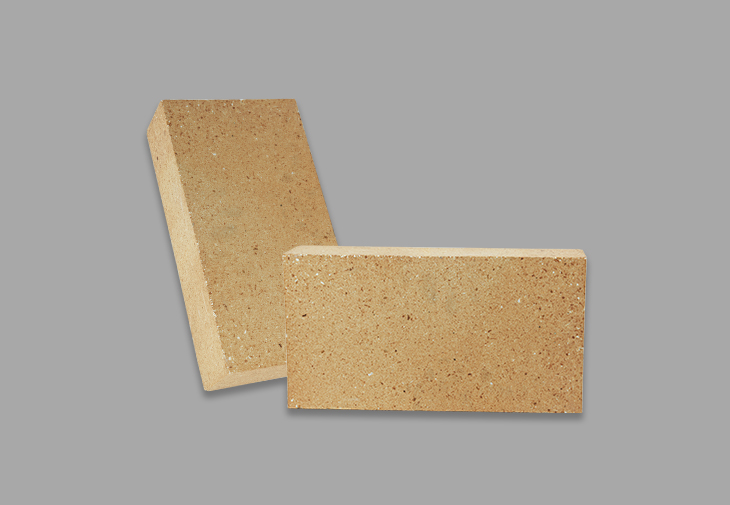
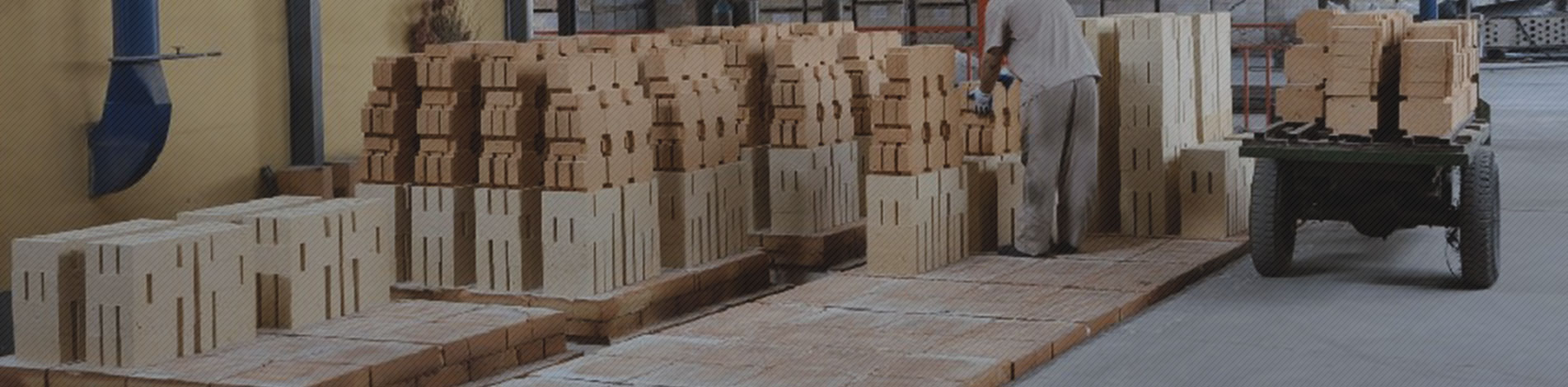

Insulation bricks — also known as insulated bricks, insulating fire bricks (IFB), or insulation refractory bricks — are lightweight porous refractory materials designed to reduce heat transfer in industrial equipment operating from 800°C to 1800°C.
With bulk density ranging from 0.6 to 1.5 g/cm³ and thermal conductivity as low as 0.15 W/(m·K) at 800°C, they cut heat loss by 20–35% compared to dense refractory bricks, lowering fuel consumption and reducing outer shell temperatures.

Highland manufactures insulating fire brick (IFB) in four ASTM C155 grades: K23 (bulk density 0.60 g/cm³, working temp 1100°C), K26 (0.80 g/cm³, 1350°C), K28 (0.90 g/cm³, 1450°C), and K30 (1.00 g/cm³, 1550°C). Al₂O₃ content 38–75% across grades. Thermal conductivity 0.22–0.42 W/m·K at 600°C. Fe₂O₃ <1.0% — suitable for reducing atmosphere service in petrochemical and hydrogen furnaces. Dimensional tolerance ±0.5mm after six-side grinding. ISO 9001:2015 certified with batch density and conductivity test reports. Standard grades ship within 35–65 working days. Submit your furnace type and operating temperature for grade recommendation.
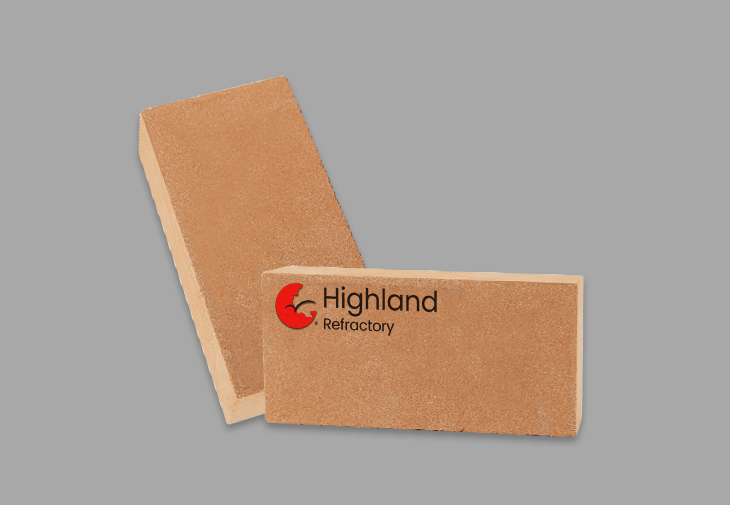
A soft refractory brick — the industry term for insulating fire brick (IFB) or lightweight refractory brick — is engineered for thermal conservation rather than structural containment. Highland manufactures soft bricks in four ASTM C155 K-series grades: K23 (1260°C, 0.60 g/cm³), K26 (1430°C, 0.80 g/cm³), K28 (1540°C, 0.90 g/cm³), and K30 (1650°C, 1.00 g/cm³). Their high porosity (60–75%) delivers thermal conductivity as low as 0.22 W/m·K at 600°C with a cold crushing strength of 1.2–3.0 MPa. The defining feature for field crews: these bricks can be cut with a standard woodworking hand saw — no diamond blade required. ISO 9001:2015 certified. Standard grades ship within 30–40 working days. Submit furnace type and operating temperature for grade recommendation.

Lightweight refractory bricks are porous refractory materials manufactured from carefully selected alumino-silicate raw materials combined with pore-forming technologies. Through controlled firing processes, these bricks achieve a low bulk density and high porosity, allowing them to provide excellent thermal insulation while remaining stable at elevated temperatures. Typical performance ranges include: Bulk Density: approximately 0.6 – 1.3 g/cm³ Maximum Service Temperature: typically 1200°C – 1600°C Thermal Conductivity: significantly lower than dense refractory bricks Cold Crushing Strength: sufficient for insulation and backup lining applications It is important to note that lightweight refractory bricks are not intended for heavy load-bearing zones.

Maximum Service Temperature: Up to 1800 degrees Celsius (3270 degrees Fahrenheit). High Alumina Purity: Typically 98 percent to 99 percent Al2O3, ensuring zero contamination for glass and sapphire growth industries. Ultra-Low Bulk Density: Ranging from 1.1 to 1.5 g/cm3. This reduces the total weight of the furnace structure, allowing for lighter steel frameworks and lower construction costs. Superior Thermal Conductivity: Our “bubble” technology provides insulation that is 3 times more effective than standard heavy firebricks, drastically cutting your monthly gas or electricity bills.
Highland manufactures insulating fire brick (IFB) in four ASTM C155 grades: K23 (bulk density 0.60 g/cm³, working temp 1100°C), K26 (0.80 g/cm³, 1350°C), K28 (0.90 g/cm³, 1450°C), and K30 (1.00 g/cm³, 1550°C). Al₂O₃ content 38–75% across grades. Thermal conductivity 0.22–0.42 W/m·K at 600°C. Fe₂O₃ <1.0% — suitable for reducing atmosphere service in petrochemical and hydrogen furnaces. Dimensional tolerance ±0.5mm after six-side grinding. ISO 9001:2015 certified with batch density and conductivity test reports. Standard grades ship within 35–65 working days. Submit your furnace type and operating temperature for grade recommendation.
A soft refractory brick — the industry term for insulating fire brick (IFB) or lightweight refractory brick — is engineered for thermal conservation rather than structural containment. Highland manufactures soft bricks in four ASTM C155 K-series grades: K23 (1260°C, 0.60 g/cm³), K26 (1430°C, 0.80 g/cm³), K28 (1540°C, 0.90 g/cm³), and K30 (1650°C, 1.00 g/cm³). Their high porosity (60–75%) delivers thermal conductivity as low as 0.22 W/m·K at 600°C with a cold crushing strength of 1.2–3.0 MPa. The defining feature for field crews: these bricks can be cut with a standard woodworking hand saw — no diamond blade required. ISO 9001:2015 certified. Standard grades ship within 30–40 working days. Submit furnace type and operating temperature for grade recommendation.
Lightweight refractory bricks are porous refractory materials manufactured from carefully selected alumino-silicate raw materials combined with pore-forming technologies. Through controlled firing processes, these bricks achieve a low bulk density and high porosity, allowing them to provide excellent thermal insulation while remaining stable at elevated temperatures. Typical performance ranges include: Bulk Density: approximately 0.6 – 1.3 g/cm³ Maximum Service Temperature: typically 1200°C – 1600°C Thermal Conductivity: significantly lower than dense refractory bricks Cold Crushing Strength: sufficient for insulation and backup lining applications It is important to note that lightweight refractory bricks are not intended for heavy load-bearing zones.
Maximum Service Temperature: Up to 1800 degrees Celsius (3270 degrees Fahrenheit). High Alumina Purity: Typically 98 percent to 99 percent Al2O3, ensuring zero contamination for glass and sapphire growth industries. Ultra-Low Bulk Density: Ranging from 1.1 to 1.5 g/cm3. This reduces the total weight of the furnace structure, allowing for lighter steel frameworks and lower construction costs. Superior Thermal Conductivity: Our “bubble” technology provides insulation that is 3 times more effective than standard heavy firebricks, drastically cutting your monthly gas or electricity bills.
Highland Refractory manufactures three categories of insulation bricks covering the full temperature spectrum:
All products are ISO 9001:2015 certified, with batch XRF chemical analysis and physical property certificates provided per order. Standard dimensions 230×114×65 mm are stocked; custom wedge, arch, skew, and keystone profiles are available at ±1 mm tolerance. For detailed technical specifications, grade selection guidance, and application data, please refer to our JM-series product page or the N-series product page.
800–1800°C
Service Temperature Range
0.6–1.5
Bulk Density (g/cm³)
≤0.6
Thermal Conductivity W/(m·K)@800°C
≥2.5
CCS (MPa)
Al₂O₃: 30–48%
Max Temp: 1430°C
Density: 0.8–1.3 g/cm³
Grade: N-1 / N-2a / N-3 / N-4 / N-6
Best for: Industrial kiln back-up lining, boilers, heat treatment furnaces.
View TDS & Price →Al₂O₃: 37–75%
Max Temp: 1650°C
Density: 0.9–1.3 g/cm³
Grade: JM23 / JM26 / JM28 / JM30
Best for: Tunnel kiln cars, ceramic kiln crown, high-temp furnace roof.
View TDS & Price →Al₂O₃: ≥48%
Max Temp: 1750°C
Density: 1.0–1.5 g/cm³
Grade: LW-1.0 / LW-1.3 / LW-1.5
Best for: Glass tank furnace, industrial heating furnace back lining.
View TDS & Price →| Type | Al₂O₃ | Max Temp | Density (g/cm³) | Thermal Conductivity @800°C | CCS (MPa) | Cost | Best For |
|---|---|---|---|---|---|---|---|
| Clay Insulation | 30–48% | 1430°C | 0.8–1.3 | 0.20–0.35 | 2.5–5.0 | ★ | Economy — general kilns & boilers |
| Mullite JM Series | 37–75% | 1650°C | 0.9–1.3 | 0.18–0.28 | 3.0–8.0 | ★★ | Standard — ceramic & tunnel kilns |
| High Alumina LW | ≥48% | 1750°C | 1.0–1.5 | 0.22–0.40 | 4.0–10.0 | ★★★ | Premium — glass tanks & high-temp furnaces |
Buyers and engineers encounter at least seven different terms referring to the same product category. This terminology variation stems from regional standards (ASTM vs ISO), industry jargon (steel vs ceramics vs glass), and simple word-order differences. The table below maps every common term to its standard equivalent so you can confidently compare products across suppliers.
| Term | Standard | Usage Context | Equivalent To |
|---|---|---|---|
| Insulation bricks | ISO 2245 | General product name — most common in international trade | — (primary term) |
| Insulated bricks | Industry variant | Used in procurement specifications and B2B platforms | Insulation bricks |
| Insulating fire bricks (IFB) | ASTM C155 | North American technical literature and standards | Insulation bricks |
| Insulation refractory bricks | ISO 2245 | Industrial purchasing — emphasizes refractory property | Insulation bricks |
| Refractory insulation bricks | Word-order variant | Same as above — reversed modifier order | Insulation bricks |
| Insulating refractory bricks | Industry usage | Common in academic literature and patent databases | Insulation bricks |
| Thermal insulation bricks | Functional descriptor | Emphasizes the thermal barrier function explicitly | Insulation bricks |
Highland Refractory manufactures all insulation bricks to ISO 2245 classification and ASTM C155 equivalent standards. Whether your engineering specification calls for "insulated bricks" or "insulation refractory bricks," the same product ships from our facility — the terminology difference does not indicate a different physical product.
The primary function of high temperature insulation bricks is to resist heat flow from the hot face to the cold face of furnace walls. Lower thermal conductivity at service temperature means less heat escapes, reducing fuel consumption and lowering the outer shell temperature for worker safety. The table below compares thermal conductivity values across the three insulation brick categories at representative service temperatures.
| Brick Type | Grade | 400°C | 800°C | 1200°C | 1500°C |
|---|---|---|---|---|---|
| Clay Insulation | N-1 | 0.16 W/(m·K) | 0.22 W/(m·K) | 0.30 W/(m·K) | — |
| Clay Insulation | N-2a | 0.20 W/(m·K) | 0.28 W/(m·K) | 0.38 W/(m·K) | — |
| Mullite | JM23 | 0.15 W/(m·K) | 0.20 W/(m·K) | 0.28 W/(m·K) | — |
| Mullite | JM28 | 0.18 W/(m·K) | 0.25 W/(m·K) | 0.32 W/(m·K) | 0.40 W/(m·K) |
| High Alumina | LW-1.3 | 0.22 W/(m·K) | 0.30 W/(m·K) | 0.42 W/(m·K) | 0.55 W/(m·K) |
Heat loss through a furnace wall is calculated as Q = λ × ΔT / d, where λ is thermal conductivity (W/(m·K)), ΔT is the temperature difference between hot and cold faces, and d is wall thickness. For a furnace operating at 1200°C with 230 mm of N-1 insulation brick, the heat flux is approximately 1564 W/m². Adding a 65 mm JM28 layer reduces this to 1098 W/m² — a 30% reduction in heat loss.
In a documented case at a steel plant heat treatment furnace, installing 50 mm of JM28 thermal insulation bricks behind the existing working lining dropped the outer shell temperature from 145°C to 65°C, cutting annual gas consumption by 18% and achieving a payback period of 11 months on material cost alone. This is why heat insulation bricks are specified not as an optional upgrade but as a standard energy-saving lining component in modern furnace design.

The following technical data sheet provides key physicochemical parameters for representative grades across all three insulation refractory bricks categories. Full TDS documents with complete test reports are available on each product page.
| Parameter | Clay N-1 | Clay N-2a | Mullite JM23 | Mullite JM28 | High Alumina LW-1.3 |
|---|---|---|---|---|---|
| Al₂O₃ (%) | ≥42 | ≥38 | ≥50 | ≥65 | ≥55 |
| Bulk Density (g/cm³) | 1.0–1.2 | 0.8–1.0 | 0.6–0.8 | 0.9–1.1 | 1.2–1.4 |
| Cold Crushing Strength (MPa) | ≥5.0 | ≥3.0 | ≥2.5 | ≥5.0 | ≥8.0 |
| Thermal Conductivity @800°C (W/(m·K)) | 0.22 | 0.28 | 0.20 | 0.25 | 0.30 |
| Reheat Linear Change @max temp (%) | ≤0.5 | ≤0.5 | ≤0.3 | ≤0.3 | ≤0.4 |
| Classification Temp (°C) | 1400 | 1350 | 1300 | 1500 | 1550 |
| Apparent Porosity (%) | 50–60 | 55–65 | 60–70 | 50–60 | 45–55 |
| Thermal Shock Resistance (cycles) | ≥6 | ≥5 | ≥10 | ≥12 | ≥8 |
The forming method directly determines density uniformity, dimensional precision, and the mechanical performance of insulation bricks. Highland Refractory employs three forming processes, each suited to different product lines and shape complexities.
| Process | Principle | Density Uniformity | Dimensional Tolerance | Suitable Shapes | Capacity | Cost Level |
|---|---|---|---|---|---|---|
| Hydraulic Press | Biaxial compression — top and bottom punches apply pressure simultaneously | Medium | ±1 mm | Standard straight, wedge, arch shapes | High (3000 pcs/shift) | Low |
| Isostatic Press | Isostatic pressing — uniform hydraulic pressure applied through flexible mold from all directions | Excellent — no density gradient | ±0.5 mm | Complex shapes: tubes, curved arches, burner blocks, tongue-and-groove | Medium (800 pcs/shift) | Medium-High |
| Casting | Slip casting — liquid slurry poured into porous plaster molds | General | ±2 mm | Thin-wall, extra-large, hollow profiles | Low (200 pcs/shift) | Medium |
Isostatically pressed bricks are formed using an isostatic press that applies uniform hydraulic pressure (up to 200 MPa) to the powder material through a flexible elastomer mold. Unlike biaxial hydraulic pressing — which applies force only from top and bottom — isostatic pressing transmits pressure equally in all directions, eliminating the density gradient that biaxial pressing creates between the pressed faces and the sides of the brick.
The result is a brick body with uniform density throughout, which delivers three advantages in service:
Highland recommends isostatically pressed bricks for burner blocks, thermocouple ports, curved kiln roof arches, and any application where the brick shape has internal features or complex external geometry. Our isostatic press handles molds up to 500 mm maximum dimension, with a working pressure range of 100–200 MPa and a compaction cycle of 4–8 minutes depending on powder compressibility.

Highland maintains standard dimensions in stock for immediate dispatch and manufactures custom shapes from customer drawings. Dimensional tolerance is ±1 mm for hydraulic-pressed shapes and ±0.5 mm for isostatically pressed shapes.
| Shape | Standard Dimensions (mm) | Tolerance | Forming Method |
|---|---|---|---|
| Straight (T-3) | 230 × 114 × 65 | ±1 mm | Hydraulic |
| Side Arch | 230 × 114 × 65/55 (taper) | ±1 mm | Hydraulic |
| End Arch | 230 × 114 × 65/59 (taper) | ±1 mm | Hydraulic |
| Wedge | 230 × 114 × 65/45 (taper) | ±1 mm | Hydraulic |
| Skew (Key) | 230 × 114 × 65 (angled end) | ±1 mm | Hydraulic |
| Tongue & Groove | 230 × 114 × 65 (interlocking) | ±0.5 mm | Isostatic |
| Curved Arch (custom) | Per drawing | ±0.5 mm | Isostatic |
| Burner Block (custom) | Per drawing with internal ports | ±0.5 mm | Isostatic |
Custom shapes are produced from customer drawings in PDF, DWG, or DXF format. Our engineering team reviews each drawing for forming feasibility and provides a quotation including mold cost (credited back on orders exceeding 10 tons of the same shape) and unit price.
Insulation bricks are specified across six major industrial sectors. Each industry has distinct temperature profiles, thermal cycling patterns, and chemical environments that determine the optimal brick grade. The table below maps each industry to its recommended grades and explains the selection rationale.
| Industry | Application Zone | Temperature Range | Recommended Grade | Selection Rationale |
|---|---|---|---|---|
| Steel & Metallurgy | Hot blast stove, reheat furnace backup lining | 1200–1450°C | N-2a / JM26 | Good thermal shock resistance for cyclic operation; cost-effective for large backup lining areas. |
| Cement | Rotary kiln preheater, cooler ducts | 1000–1300°C | N-1 / N-2a | Resistant to alkali vapor attack; sufficient refractoriness for preheater zones. |
| Ceramics | Tunnel kiln car decks, kiln crown | 1300–1500°C | JM26 / JM28 | Low thermal storage reduces kiln car heat absorption — improves firing cycle efficiency. |
| Glass | Regenerator crown, annealing lehr backup | 1400–1650°C | JM28 / LW-1.3 | High refractoriness under load at glass tank operating temperatures; resists batch dust contamination. |
| Petrochemical | Cracking furnace, reformer backup lining | 1200–1400°C | N-1 / JM23 | Stable under reducing atmosphere; low iron content prevents catalyst poisoning. |
| Power Generation | Boiler walls, flue gas ducts | 800–1200°C | N-4 / N-6 | Lightest density option minimizes structural load on boiler steelwork; adequate for moderate temperatures. |
For detailed grade selection guidance by furnace zone — including working lining vs backup lining recommendations, thermal gradient calculations, and installation specifications — please contact our engineering team with your furnace type and operating parameters.

ISO 9001
:2015 Quality Management
100%
Batch XRF Tested
Per Order
Physical Property Certificates
30+ Years
Manufacturing Experience (Since 1990)
Every batch of insulation bricks undergoes a three-stage quality control process to guarantee consistent performance across all insulation bricks shipped to global customers:
Founded in 1990 in Xinmi, Henan — China's refractory raw material hub — Highland operates its own raw material processing, forming, firing, and finishing lines. With 1,100 skilled workers and 6 tunnel kilns, we control production lead time and quality without depending on third-party trading companies. You deal directly with the factory.
Beyond insulation bricks, Highland manufactures dense fire clay bricks, high alumina bricks, magnesia carbon bricks, AZS refractories, castables, and ceramic fiber products. One supplier, one shipment, one quality standard for all insulation bricks and dense bricks — saving you procurement coordination time and mixed-supplier logistics cost.
Standard N-series and JM-series shapes are produced from stock molds, enabling 30-day lead time for standard orders. Custom isostatically pressed shapes require 40–60 days including mold fabrication. ISO 9001:2015 quality system ensures consistent output — no batch-to-batch surprises.
Insulation bricks are lightweight (0.6–1.5 g/cm³), high-porosity products designed to resist heat flow — they reduce heat loss through furnace walls. Dense refractory bricks (2.0–3.0 g/cm³) are designed for direct flame contact, mechanical abrasion, and slag resistance in the working lining. In a typical furnace wall, dense refractory bricks form the hot-face working lining and insulation bricks form the backup layer behind it — the two products serve different functions and are installed together, not interchangeably.
Generally, no. Insulation bricks are designed for back-up lining and heat conservation, not direct flame, slag, or mechanical abrasion contact. For hot-face zones, dense refractory bricks (high alumina, magnesia, or corundum) should be used. An insulation layer behind the working lining significantly reduces heat loss and improves energy efficiency. The exception is JM28 and JM30 grades, which can withstand limited direct flame contact in ceramic kiln crowns where flame impingement is controlled.
Yes. We manufacture standard bricks (230×114×65 mm) and custom profiles including arch bricks, wedge bricks, tapered, tongue-and-groove, curved arches, and burner blocks. Dimensional tolerance is ±1 mm for hydraulic-pressed shapes and ±0.5 mm for isostatically pressed shapes. Please submit your kiln layout drawing (PDF, DWG, or DXF) for a quotation including mold cost and unit price.
"Insulated bricks" and "insulation bricks" refer to the same product category — the term variation is regional and not technical. Both describe lightweight porous refractory bricks engineered for thermal insulation. "Insulated bricks" appears more frequently in procurement specifications on B2B platforms, while "insulation bricks" is the standard term used in ISO 2245 and ASTM C155 classification documents. Highland supplies both under the same product lines and quality standards.
High temperature insulation bricks from Highland cover service temperatures from 800°C to 1750°C depending on grade: Clay N-6 (800°C), N-4 (1000°C), N-1 (1430°C); Mullite JM23 (1300°C), JM26 (1400°C), JM28 (1500°C), JM30 (1550°C); High Alumina LW-1.0 (1600°C), LW-1.3 (1650°C), LW-1.5 (1750°C). Classification temperature is the maximum temperature at which the brick maintains less than 0.5% reheat linear change after 12-hour exposure — actual service temperature should be selected with a safety margin of 50–100°C below classification.
Isostatically pressed bricks are formed by applying uniform hydraulic pressure (up to 200 MPa) through a flexible elastomer mold, compressing the powder equally from all directions. This eliminates the density gradient found in biaxial-pressed bricks, producing uniform thermal expansion, consistent thermal conductivity, and higher strength at complex geometries. They are recommended for burner blocks, thermocouple ports, curved kiln roof arches, and any shape with internal cavities or curved surfaces where standard pressing leaves weak zones.
Fire clay insulating bricks (N-series) are suitable for ceramic kiln backup lining and car decks in tunnel kilns operating up to 1300°C. For ceramic kiln crowns or zones exposed to higher temperatures (1300–1500°C), we recommend upgrading to JM26 or JM28 grades, which offer superior thermal shock resistance and lower thermal conductivity at elevated temperatures. See our N-series product page for TDS details.
Insulation refractory bricks are classified under ISO 2245 (shaped insulating refractory products — classification) and ASTM C155 (Standard Classification of Insulating Firebrick). The ISO classification uses a format of "density-max service temp-linear change on reheating" (e.g., 125-1.5-L means 1.25 g/cm³ class density, 1500°C classification temperature, L grade reheating). ASTM C155 uses grade numbers corresponding to the classification temperature in hundreds of degrees Fahrenheit (e.g., Grade 26 = 2600°F = 1427°C). Highland certifies products to both standards.
For product-specific technical data sheets and ordering information, visit the individual product pages below:
Al₂O₃ 30–48%, up to 1430°C, density 0.8–1.3 g/cm³. TDS, grade comparison, and pricing.
Al₂O₃ 50–75%, up to 1650°C, density 0.6–1.3 g/cm³. Full JM series TDS and applications.
High alumina lightweight bricks, up to 1750°C. LW series TDS and selection guide.
Soft insulating fire brick for pottery kilns, forges, and heat treatment furnaces.
Foamed alumina insulation brick with ultra-low density for extreme temperature insulation.
Dedicated JM28 grade product page — specifications, applications, and ordering details.
Send your grade requirement, quantity, operating temperature, and drawings — we respond within 12 hours.
Get Quote Now